Posts

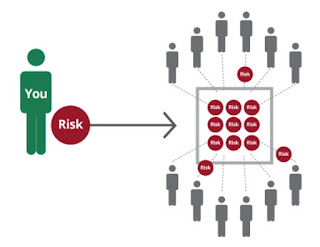
Risk Pooling

Image
Risk Pooling Risk pooling simply means sharing the potential costs of risks among a large group of individuals or entities. By combining everyone's resources, the financial burden associated with any individual experiencing a loss becomes smaller and more manageable. This principle forms the foundation of all insurance models. There are basically two types of Risk Pooling: A. Formal insurance: Offered by companies, where individuals pay premiums and receive specific coverage in case of certain events. B. Informal risk-sharing arrangements: Groups like communities or families may create their own systems for mutual aid and support in times of need. When considering rusk pooling we understand individuals with a higher risk of making claims might be more likely to join the pool, which gives rise to the principle of moral hazard making the insurance more riskier. This is why a good mechanism must be put in place to ensure contribution and distribution of resources within the poo...

Joint Vs Composite Insurance

Image
Joint Vs Composite Insurance Both joint insurance and composite insurance involve insuring multiple interests under one policy, but they have distinct characteristics and cater to different needs. Here's a breakdown of the key differences: Joint insurance exists where two or more parties with individual interests in the same property take out a single insurance policy. A typical example is a husband and wife jointly insuring their home. Joint Insurancce = Equal ownership and interest. Whereas composite insurance exists where two or more persons with a separate interest in the subject matter of the insurance, are insured parties in the same insurance contract. A typical example would be a mortgagor and a property owner or a contractor and sub-contractor." Composite Insurance = Distinct and separate interests The appropriate choice between joint and composite insurance depends on your specific situation: -For personal assets like jointly owned houses or vehicles, joint ...

Inland Marine Insurance

Image
Inland Marine Insurance Inland marine insurance (IMI) is a specialized type of insurance that protects movable property and equipment while it is being transported on land within a country's borders. It's important to note that it differs from traditional property insurance as it covers property in transit, while property insurance covers property at a fixed location. IMI covers specialized high-value assets that property insurance typically doesn’t cover. Inland marine insurance covers losses to five types of business property: 1-Property that is moving over land between locations (e.g., construction equipment) 2-Property that you keep at an off-site warehouse or facility (e.g., vending machines stored at a customer’s site) 3-Property that is stored in a moving vehicle (e.g., a food truck) 4-Property that is part of infrastructure (e.g., bridges, communication towers that an insured owns) 5-High-value property stored at your fixed location (e.g., another person's artw...

Experience Refund

Image
Experience Refund An experience refund in insurance refers to a portion of the premiums paid by a policyholder that is returned to them if the insurer's experience with the policy is better than expected. In other words, if the insured individual or business exhibits lower-than-average claims activity or generates higher-than-average profits (depending on the type of insurance), they may be eligible for a refund. Experience refunds can benefit both policyholders and insurers: For policyholders: They receive a financial reward for responsible behaviors or favorable circumstances, incentivizing risk mitigation and reducing claims. For Insurers: It fosters stronger relationships with policyholders by demonstrating fairness and transparency in premium allocation. There are three main types of experience refunds: 1. Policyholder Level: This type of refund is credited directly to the policyholder's account at the end of the policy period. It's typically offered with individ...

Verification

Image
Verification Insurance verification is the process of confirming the validity and accuracy of the information provided by an insured individual or business. It's a crucial step for insurers to assess risk accurately and ensure they can fulfill their obligations under the policy. There are different types of verification in insurance, each focusing on specific aspects of the policy: 1. Eligibility verification: This confirms whether the applicant meets the criteria to be insured under the specific policy. It involves checking factors like age, location, health, property ownership, and occupation. 2. Coverage verification: This ensures the policy covers the specific risks and perils the insured wants protection against. It involves reviewing the policy wording, exclusions, and limitations. 3. Premium verification: This confirms the accuracy of the calculated premium based on the verified risks and coverage. It involves reviewing factors like deductibles, co-pays, and payment ...

Index-Based Or Parametric Insurance

Image
Index-Based Or Parametric Insurance Index-based insurance, also known as parametric insurance, is a relatively new and innovative approach to providing financial protection against risks, particularly in agriculture and disaster-prone areas. Unlike traditional indemnity insurance that relies on claims assessments after an event, index-based insurance uses predetermined indices to determine payouts, making the process faster, more objective, and often more affordable. Index-based insurance is highly applicable in areas such as: 1) Agriculture: Protecting farmers against losses due to drought, excessive rainfall, or other weather events. 2) Disaster relief: Providing rapid financial assistance to communities affected by earthquakes, floods, or other natural disasters. 3) Livestock insurance: Protecting against livestock mortality or morbidity due to disease or weather. Here index base insurance works: -Index development: A relevant index is chosen to reflect the risk being insure...

Material Misrepresentation

Image
MATERIAL MISREPRESENTATION Material misrepresentation in insurance occurs when an insured person makes a false or misleading statement about a significant fact on their insurance application or during the claims process. This can lead to the insurer denying coverage or cancelling the policy. For instance, the policyholder provides false information regarding the location of the insured property. Material misrepresentation may be: A) Intentional misrepresentation: This occurs when the insured person deliberately makes a false or misleading statement. For example, someone might intentionally lie about their driving history on an auto insurance application in order to get a lower rate. B) Unintentional misrepresentation: This occurs when the insured person makes a mistake or forgets to disclose something important. For example, someone might forget to mention a previous health condition on a life insurance application. For a misrepresentation to be considered material, it must mee...