Posts

AUTOMOBILE INSURANCE
Image
AUTOMOBILE INSURANCE Automobile insurance is a financial product that protects car owners from financial loss in case of an accident, theft, or other damage to their vehicle. It also provides coverage for liability claims arising from injuries or property damage caused to others by the insured driver. This will be in exchange for you paying a premium, the insurance company agrees to pay your losses as outlined in your policy. There are different types of auto insurance coverage available, and the specific coverage you need will depend on your individual circumstances, such as the value of your car, your driving habits, the type and value of your car, your driving record, your age, your location, your credit score, minimum insurance requirements of a particular jurisdiction. Here are some of the most common types of auto insurance coverage: 1- Liability coverage: This covers costs associated with injuries or property damage caused to others by the insured driver. It typically co...
SURETY BOND

Image
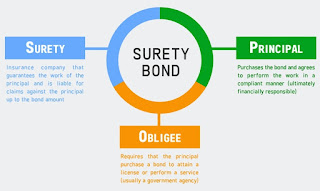
SURETY BOND A bond in which the surety agrees to answer to the obligee for the non-performance of the principal (known as the obligor). Surety bonds are financial instruments that function like a three-party guarantee. Here's how surety bonds work. The Three Parties Involved: 1- Principal: The person or business who needs the bond and guarantees completing a specific obligation. 2- Obligee: The party requiring the surety bond as a form of financial protection. It can be an individual, government entity, or another business. 3- Surety: The company that issues the bond and assumes the financial responsibility if the principal fails to fulfill their obligations. This is how surety bonds work; If the principal defaults on their obligations as outlined in the bond agreement, the obligee can make a claim against the surety bond. The surety will then investigate the claim and, if valid, pay out the obligee up to the guaranteed amount of the bond. Subsequently, the surety will pursue...

PRE-CERTIFICATION AUTHORIZATION (prior authorization, pre-approval, or pre-certification)

Image
PRE-CERTIFICATION AUTHORIZATION (prior authorization, pre-approval, or pre-certification) It is a process commonly used in health insurance plans. It requires approval from the insurer before a specific medical service is provided to the insured patient. A cost containment technique which requires physicians to submit a treatment plan and an estimated bill prior to providing treatment. This allows the insurer to evaluate the appropriateness of the procedures, and lets the insured and the physician know in advance which procedures are covered and at what rates benefits will be paid. Purpose: -Cost Control: Health insurance companies utilize pre-authorization to manage healthcare costs by ensuring that only medically necessary and cost-effective services are covered. -Quality Care: It can also play a role in ensuring appropriate treatment is provided by reviewing if the proposed service aligns with established medical guidelines. -Utilization Management: Pre-authorization is a fo...

HELD COVERED

Image
HELD COVERED A provisional acceptance of risk, subject to confirmation at a later date that the agreed cover is needed. Where applicable to an existing insurance, cover is conditional, in practice, on prompt advice to the Underwriter as soon as the Assured is aware of the circumstances to be held covered coming into effect, and a reasonable additional premium is payable if the risk held covered comes into effect. Extends coverage for a limited period even if a policy provision might have been technically breached by the insured. It essentially acts as a safety net for the insured (policyholder) in case of certain circumstances that might otherwise invalidate their coverage. Example: imagine a cargo ship insured for a specific route. The captain decides to take a slight detour to avoid a reported storm. This deviation technically breaches the policy wording. However, if the captain promptly informs the insurer and the detour is minor, the "held covered" clause might temp...

Priority

Image
Priority In reinsurance, priority refers to the sharing of losses between the insurer (ceding company) and the reinsurer. It dictates the order in which each party bears the financial burden of a covered loss. There are two main types of reinsurance treaties that utilize priority: 1- Excess of Loss (XL) Reinsurance: Here, the priority is a specific dollar amount (deductible) that the ceding company must pay for each and every covered loss. Scenario: Imagine a reinsurance treaty with a $50,000 excess of loss (XL) clause. If an insured event results in a $100,000 loss, the ceding company would first pay the initial $50,000 (priority/deductible). The reinsurer would then cover the remaining $50,000 2- Stop-Loss Reinsurance: In this type of reinsurance, the priority is an aggregate loss limit for a defined period (e.g., annual). Scenario: Let's say a stop-loss treaty has a $1 million annual loss limit. The ceding company retains responsibility for all covered losses throughout t...

SEAWORTHINESS WARRANTY

Image
SEAWORTHINESS WARRANTY seaworthiness warranty is a crucial promise made by the assured (vessel owner) to the insurer. There is an implied warranty in every voyage policy that the ship must be seaworthy at the commencement of the insured voyage or, if the voyage is carried out in stages, at the commencement of each stage of the voyage. Types of Seaworthiness: 1- Voyage Seaworthiness: The vessel must be seaworthy for the specific voyage it's undertaking, considering factors like route, weather conditions, and cargo being carried. 2- Port Seaworthiness: If the policy applies while the vessel is in port, it should be reasonably fit to encounter the ordinary perils encountered within that port (e.g., strong currents, potential collisions with other docked vessels). To be seaworthy, the ship must be reasonably fit in all respects to encounter the ordinary perils of the contemplated voyage, property crewed, fuelled and provisioned, and with all her equipment in proper working order....

First-party Cyber Liability Insurance

Image
First-party Cyber Liability Insurance First-party cyber liability insurance provides financial assistance to mitigate the impact of data breaches and cyberattacks at your small business. Any business that stores electronic data, especially sensitive customer information, is at risk of cyberattacks. This includes businesses of all sizes and across various industries. First-party cyber liability insurance typically covers: 1- Response Costs: This covers the expenses incurred in responding to a cyberattack, such as hiring forensic investigators to identify the source of the breach, notifying affected customers and data breach regulators, and engaging public relations specialists to manage reputational damage. 2- Business Interruption: If a cyberattack disrupts your normal operations, this coverage can help compensate for lost revenue during the downtime. 3- Data Recovery: The costs associated with restoring lost or corrupted data can be significant. This insurance can help cover th...